
Written by Jeremiah Coca
Summer may be a quieter time on campus, but across the Florida State University (FSU) School of Information (iSchool), our faculty and students continued to grow, review and present research, and engage in conversations that can shape the future of information science.
A major focus this summer was the rapidly evolving field and hot topic of artificial intelligence (AI). Dr. Seul Lee presented research on AI literacy, education, ethics, and governance at many academic conferences and AI bootcamps in the United States and South Korea. Together, her presentations highlighted an interconnected program of scholarship centered on responsible AI use.
Dr. Lee emphasized that AI literacy extends well beyond simply knowing how to use AI tools. It also requires understanding how AI systems produce information, critically evaluating their outputs, recognizing embedded biases and institutional values, and determining where human judgment and accountability needs to remain central.
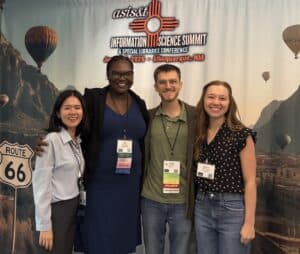
Our students also represented the iSchool at the Information Science Summit and Special Libraries Conference (ISS-SLC), organized by the Association for Information Science and Technology (ASIS&T).
Jiwoo Seo, a PhD student in the School of Information, presented her poster, “Beyond Automation: Why Human Experts Volunteer in Biomedical Ontology Communities in the Generative AI Era.” Seo credited her iSchool faculty mentors, including Dr. Sullivan, Dr. Stvilia, and Dr. He, saying, “this research was a product of Dr. Stvilia’s LIS 6205 Seminar in Information Behavior.”
Craig Moore, an MSIT student and Administrative Specialist for the FSU Innovation Hub, delivered a lecture titled “Balancing Resources and Services to Support Access to Emerging Technologies.” His presentation examined how organizations can structure access to emerging technologies through strategic planning and thoughtful technology procurement. Using computer labs, basic 3D printing, and advanced fabrication as case studies, Moore explored the distinction between resources and services and how those models can support technology access in practice.
For Moore, the conference was especially meaningful as both the inaugural ISS-SLC following the merger of the Special Libraries Association with ASIS&T and his first-ever conference presentation. He expressed gratitude for the ASIS&T community and his colleagues at the Innovation Hub.
The iSchool was also represented by Isis Malcolm, a PhD student and scholarship winner for the 2026 ISS-SLC, and Sarah Evans, Graduate Academic Program Specialist.
While Florida was at its peak heat index, our team was advancing responsible AI literacy, exploring access to emerging technologies and sharing new research with the broader information science community. Their work reflects the iSchool’s continued commitment to preparing information professionals and scholars to understand the technologies, systems, and communities transforming our world and to be a part of that transformation.