
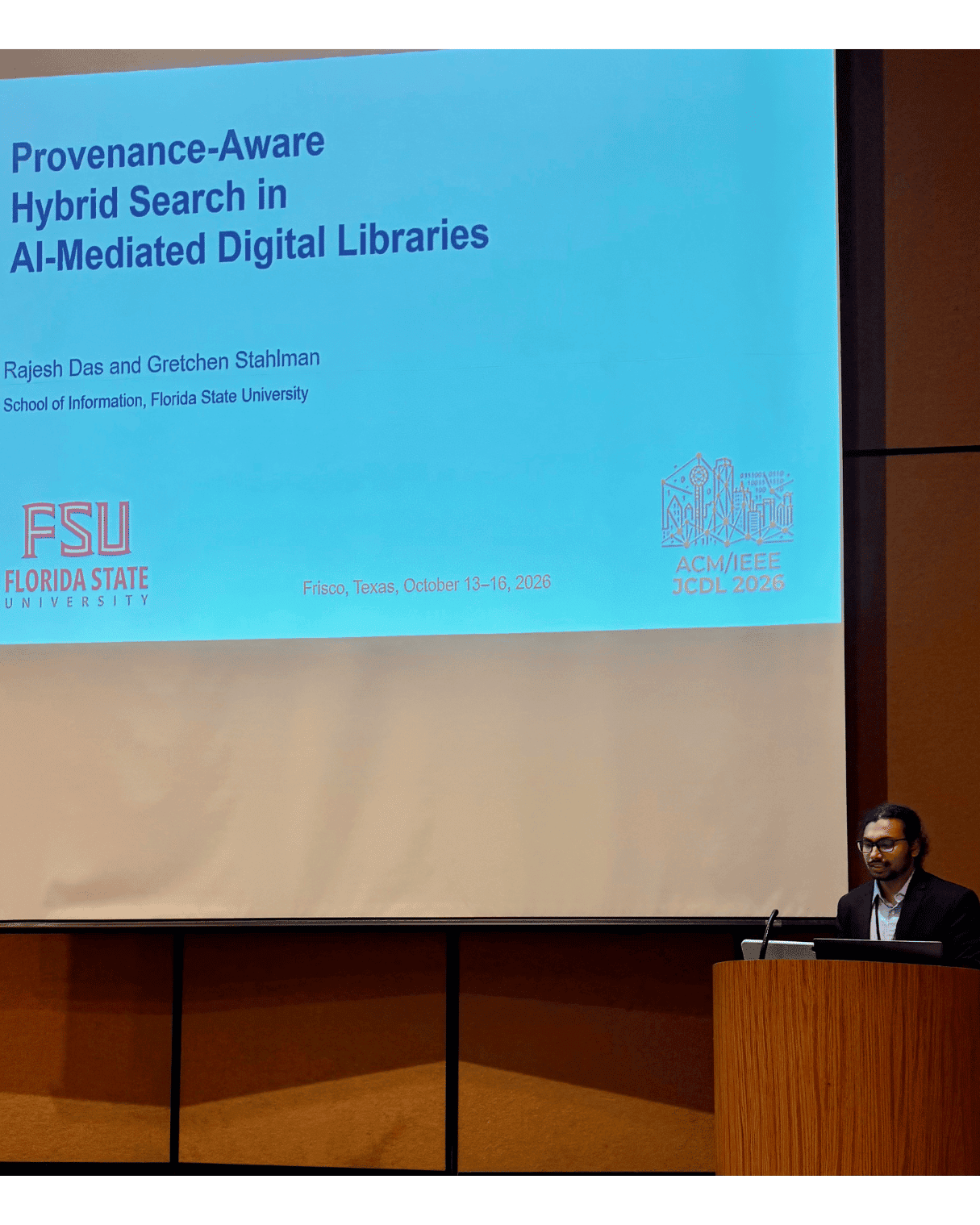
 School of Information (iSchool) Ph.D candidate and graduate teaching assistant Rajesh Das attended the 2026 ACM/IEEE Joint Conference on Digital Libraries (JCDL) in Dallas, Texas that was held on October 13 through 16. The conference brings together researchers and practitioners to explore the technical, practical, and social dimensions of digital libraries.
Das participated in the conference as a presenter, Doctoral Consortium participant, and session chair, sharing his research and engaging with scholars exploring the future of information and digital library technologies.
His research focuses on transparency and trust in AI-mediated digital libraries, specifically on how researchers can evaluate information generated by AI systems. Central to this approach is provenance, which describes where information came from and how it was produced or changed. Das presented ‘Provenance-Aware Hybrid Search in AI-Mediated Digital Libraries’, coauthored with his advisor, Dr. Gretchen Stahlman. In the paper, they propose a framework that connects AI-generated answers to their underlying sources and supporting information. His broader doctoral research explores scientific data discovery and reuse, including how researchers assess the ways data were collected, processed, and documented before deciding whether to use them.
“I aim to investigate how AI-assisted discovery can support those judgments. For me, trust should come from being able to examine the evidence behind an answer,” Das said.
The conference’s Doctoral Consortium provided an opportunity for Das to receive valuable feedback on his work. One suggestion that resonated with him the most was the importance of evaluating his framework with users to determine whether visible provenance information actually helps researchers make informed decisions.
The feedback encouraged him to consider creating a prototype that would allow researchers to explore sources and provenance information while identifying what users find helpful and where clarity is needed.
“The discussion also encouraged me to clarify which scientific datasets and research tasks to prioritize,” Das said
 Beyond presenting his research, Das chaired the “Research Integrity and Scholarly Records” paper session, where he introduced presenters and facilitated scholarly discussion. One presentation that stood out to him explored how readers can locate specific evidence within cited sources, reinforcing the importance of making research information easier to verify.
“The experience encouraged me to listen across different research perspectives and find connections among them. It also helped me feel more confident participating in the scholarly community through both research and service,” Das said.
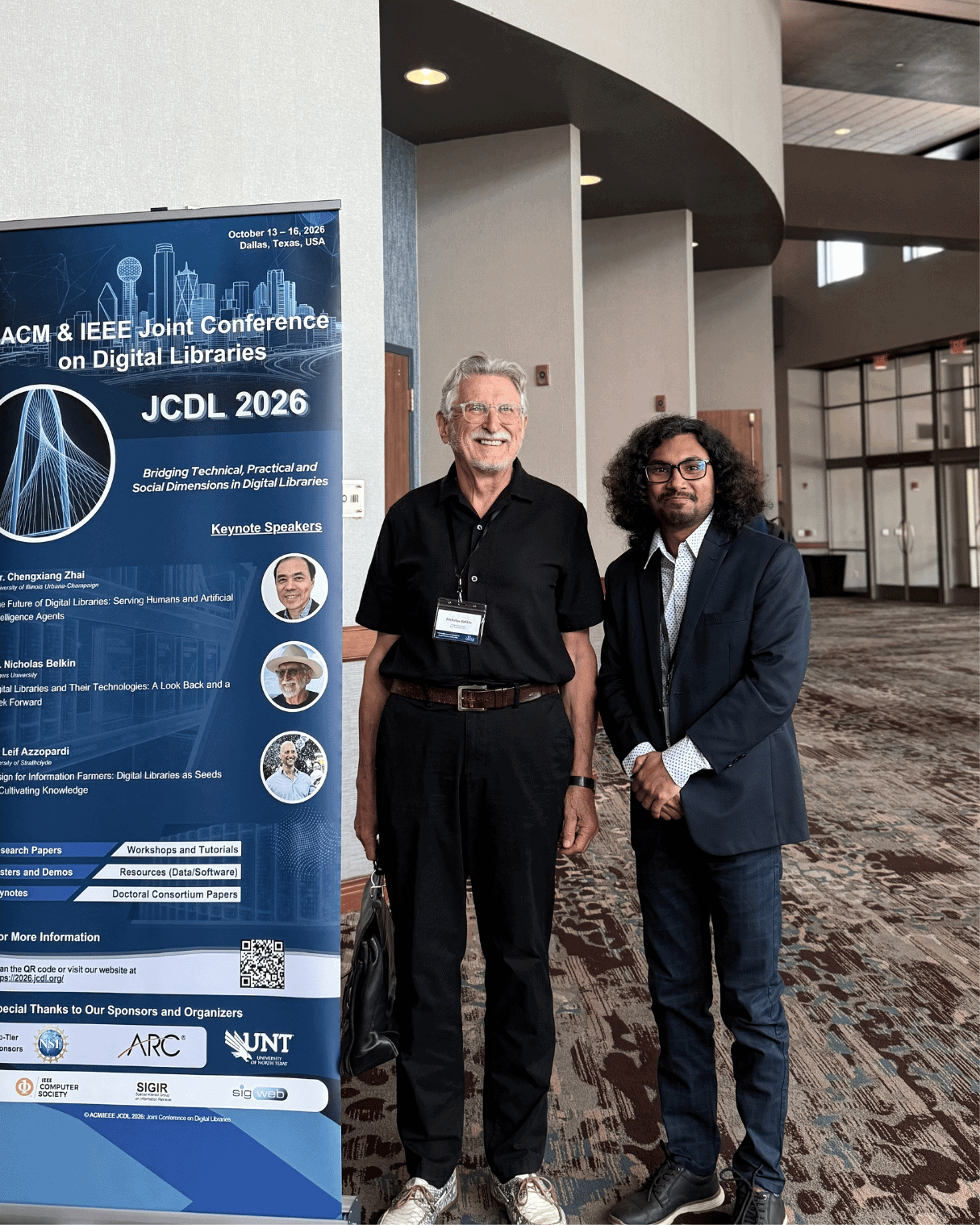
Another highlight to his experience was meeting Professor Nicholas Belkin, whose work on the Anomalous State of Knowledge (ASK) theory and information seeking has influenced Das’s understanding of information strategy. Belkin’s research highlights how people’s approach to seeking information change as they learn, which is a concept Das sees relevant to scientific data discovery.
Das hoped to attend JCDL since his undergraduate years, and he described this experience as an opportunity to connect with scholars whose work he had previously encountered through research papers.
“I returned with new connections and a stronger interest in collaboration across information science and computing,” Das said.
Looking ahead, Das hopes to improve how researchers discover, understand, and responsibly reuse scientific data and information. He envisions AI generated answers serving as starting points for further inquiry, with clear paths back to evidence supporting them.
“I am especially grateful to my advisor, Dr. Gretchen Stahlman, for her guidance, encouragement, and support in making this experience possible. I also appreciate the support of FSU’s School of Information and Congress of Graduate Students (COGS),” Das said.