
School of Communication Science & Disorders (SCSD) doctoral scholar Holden Allen and undergraduate scholar Hannah Figueras are helping drive the conversation around artificial intelligence (AI) in the field of Communication Science and Disorders (CSD) through newly published research examining how students perceive and use AI in school.
Together, Allen and Figueras co-authored the manuscript, “Opening Pandora’s Box: Perceptions and Usage of AI by Undergraduate and Graduate CSD Students,” which was recently accepted for publication in Perspectives of the ASHA Special Interest Groups, a peer-reviewed scholarly journal that features a variety of article types and covers many CSD subject areas. The article reports findings from a nationwide survey of 224 CSD students and explores both the promise and uncertainty surrounding AI’s growing role in academic and clinical preparation. The project was completed under the mentorship of Dr. Michelle Therrien and SCSD Director Dr. Carla Wood.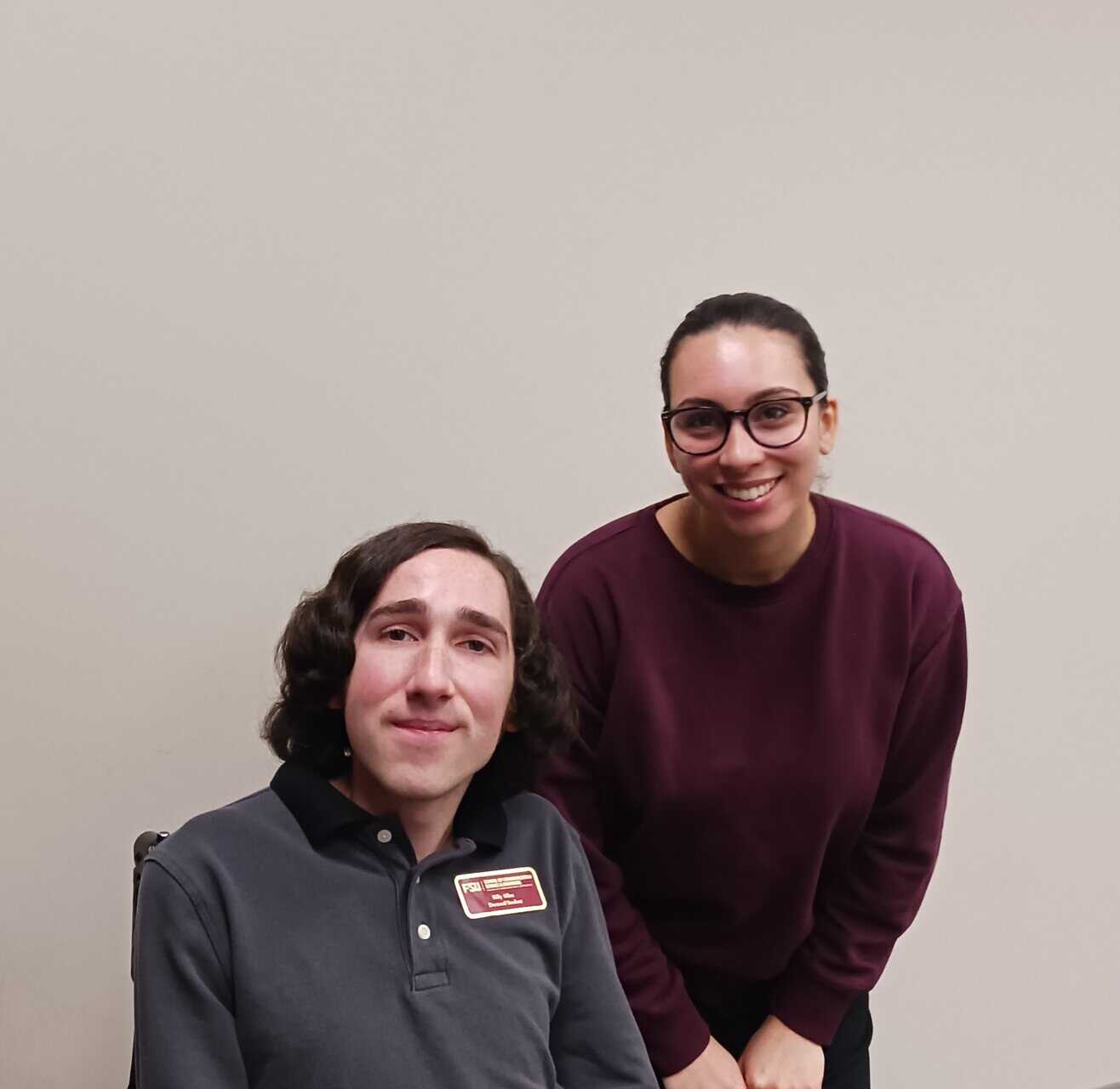
For Allen, the publication marks a significant milestone. As a graduate of Longwood University in Farmville, Virginia, where he completed both his bachelor’s and master’s degrees in CSD, Allen said publishing peer-reviewed research at this stage of his career carries immense weight.
“Professionally, this article operates as a way for me to receive formal recognition as a researcher investigating AI,” Allen said. “I felt establishing myself as a researcher doing work on AI was important given its current popularity, and since I personally hope to investigate this topic area further in my future career.”
Allen’s interest in the topic was shaped by his own experiences in education and by connecting with students whose academic journeys began alongside rapid advancements in AI technology. Prior to AI usage being as mainstream as it is today, Allen worked as a tutor and had an immense interest in gaining insights as to how its usage would affect his field’s educational programs.
“I feel one of the most impactful findings from our survey was that the overwhelming majority of students desired greater clarity around how to use AI technologies in their education,” Allen said.
Allen believes these findings point to the need for specific outlines on how to approach using AI in education.
“Every program is different,” Allen said. “For instance, AI usage guidelines in an English program will look very different from those in a computer science program. As a result, I hope we will stay away from blanket, one-size-fits-all guidelines for AI and instead recognize that AI usage frameworks will vary from program to program, and even class to class.”
The project also marked Allen’s first experience collaborating closely with an undergraduate student serving as a research assistant and co-author. He states that it’s something he encourages his peers at the graduate level to do since it’s given him the opportunity to learn about supporting and guiding future professionals.
The undergraduate collaborator, Hannah Figueras, became involved in the project after meeting Allen in April 2025.
“He shared with me the insights on the project so far, and I was extremely interested in the topic of AI usage and perspectives as it is rapidly expanding in our field and many other professions as well,” Figueras said.
As a research assistant and co-author, Figueras took on a wide range of responsibilities. She conducted structured literature reviews of American Speech-Language-Hearing Association journals, coded qualitative survey responses, and helped develop visual representations of data.
The response that stood out to Figueras the most was a participant who expressed that if there are no clear guidelines, it can become difficult to find the boundaries, leading to a shallow understanding of material if used as a shortcut. She asserts that this perspective displays the significant need for more direct AI regulations in CSD programs.
Beyond the publication itself, Figueras emphasized the value of mentorship and collaboration that came with the project.
“At first, I was unsure how I could become involved as a research assistant without other credentials of research engagement, but I was thrilled to be invited to participate in this project,” Figueras said. “My role in the Perspectives of AI study provided the opportunity for me to contribute to ASHA literature, develop new findings on AI perspectives, and network with other faculty and students in the CSD field.”
Together, Allen and Figueras hope their work encourages continued dialogue around the responsible integration of AI in CSD education.