
College of Communication and Information (CCI) students Jad Dargam and Angel-Amon presented their research at the Florida Undergraduate Research Conference (FURC) in Jacksonville.
Like many undergraduate researchers, their work began with a simple question. From there, their topics ranged from the digital ethics of the Metaverse to the representation of Black-Canadian hip-hop artists. Both researchers share a common goal: stepping outside the “academic bubble” to see how their work impacts the real world.
Jad Dargam, an Information Technology student at CCI’s School of Information (iSchool) expresses how self-representation through virtual avatars is a core driver of identity and engagement in immersive environments.
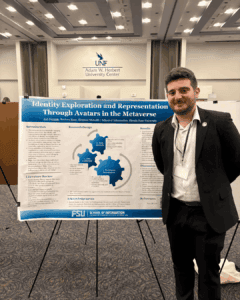
He uses qualitative methodology, conducting a series of interviews to examine how interviewees’ senses of identity, social belonging, and psychological welfare connect to consistent use of the metaverse.
“Interviewees expressed that avatars were a digital extension of their personal and social identity. Avatars assisted them in expressing themselves, joining specific groups, and projecting an optimal social status,” said Dargam. “Avatars are a medium for identity experimentation, allowing users to explore alternative versions of themselves without the constraints present in the physical world. They are not just playable characters, but instead a dynamic tool to create accessible interaction and collaboration within the metaverse.”
Angel-Amon Wildgoose, a CCI Media Communications Studies student, presented qualitative research on Black-Canadian hip-hop artists. She uncovered that Canadian media had anti-Black practices, often suppressing Black voices.
“As naïve as that question was, it led me down a path of questioning how the Canadian media communicates Black-Canadian hip-hop artists,” Wildgoose said. “Are Black voices limited, muted, or marginalized, and why? What I have found is that Canadian broadcasting and media groups have used anti-Black practices that were detrimental to the Black community; however, through education centers (UofT HartHouse) and social media, Black-Canadian hip hop artists are securing their own opportunities to tell their stories.”
Similarly, Dargam reflects on the importance of collegiate research and presentations. Presenting to a broad audience challenges researchers to share their findings clearly and effectively, an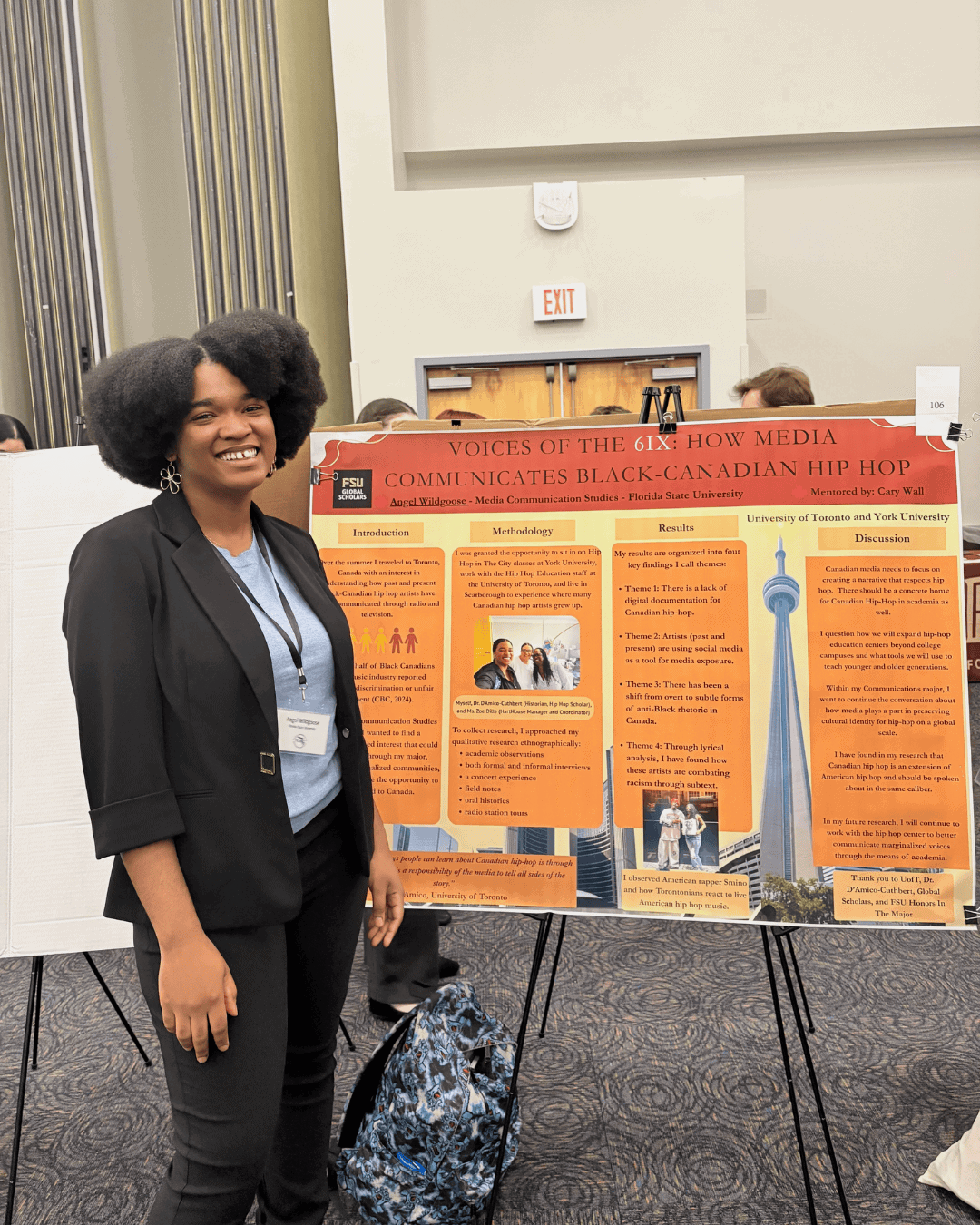 essential step in building a professional identity and preparing for a successful career in any path.
“Presenting at this level is vital because it allows students to exchange ideas with experts outside of their own bubble, fostering a broader understanding of how their work impacts the real world. These conversations often reveal hidden connections between different fields, encouraging the kind of collaborative thinking that leads to more well-rounded and innovative research,” said Dargam.
Both attendees shared gratitude towards the professors and mentors who helped make their research possible.
“Thank you to Dr. Toby Graves and Dr. Braidyn Lazenby from the School of Communication. Thank you for your help and patience always. Also, thank you to Dr. Maria Ryan from the College of Music for being on my committee,” said Angel-Amon Wildgoose.
Jad Dargam said, “This project would not have been possible without the invaluable help and guidance of the Principal Investigator, Rasleen Kaur, and our Faculty Advisor, Dr. Shuyuan Metcalfe, whose mentorship has been instrumental to our success.”