
While earning her Ph.D. in Communication Theory and Research from Florida State University’s (FSU) School of Communication, Dr. Sun Young Park collaborated with Drs. Jaejin Lee and Braidyn Lazenby in her publication, “Gut health goes viral: analyzing influencer advertising for dietary supplements on TikTok”.
This research examined how TikTok creators discuss gut health and promote related products. Through her findings, Park explored how social media influences consumers’ perceptions of gut health and may discourage viewers from conducting their own research. 
“At the time I started doing this, around 2023, I saw so many TikTok videos talking about how to have a healthy gut, and at that time a lot of gut health-related products were coming out, but I knew gut health was way more complicated than that,” said Dr. Park.
As Park began her research, she noticed that many creators lacked professional expertise and failed to provide clear information about the products they recommended, raising questions about how consumers receive health advice on social media.
“We looked at the people first and saw what their credentials were, and we found that more than 70% of them had no credentials,” said Park. “We also found that 28% of people weren’t even identifying what the product they were promoting actually was. Was it a pill, a powder, a dietary supplement?”
Rather than providing evidence or explanations, many TikTok creators relied on keywords to attract viewers and promote gut health products. Their content often promoted these products for a broad audience, leaving little to no room to acknowledge the individual differences that influence gut health.
“Gut health is the balance of your microorganisms and digestive tract. The gut is one of the most understudied organs because it is so complicated and highly personalized. So I was confused why products were being promoted for a healthy gut,” said Park.
O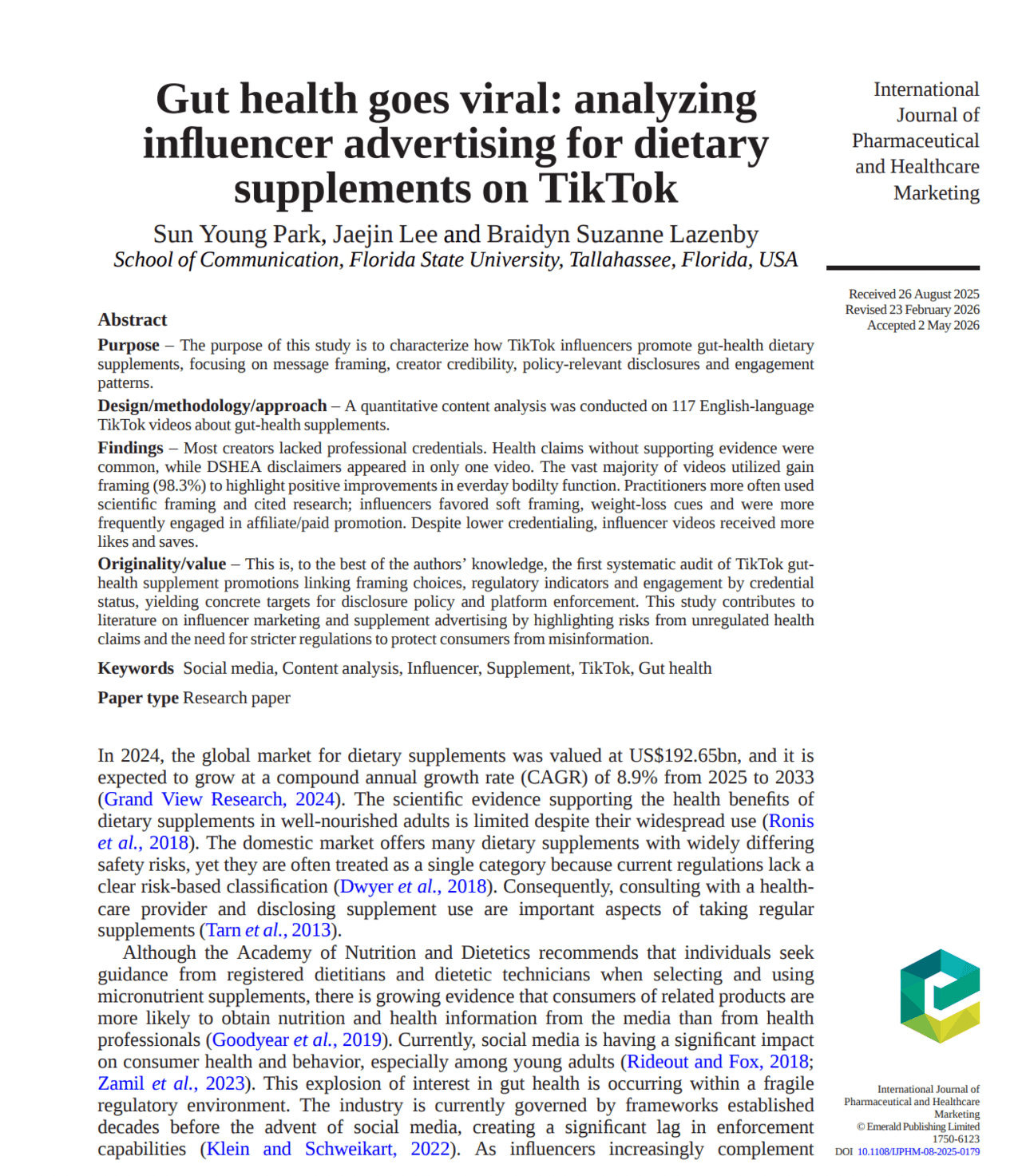 ver the past decade, social media has changed the way creators promote ideas, products and events. As new platforms and short-form videos have grown in popularity, creators have had to adjust their content to keep up with what audiences want and how they consume information.
“With TikTok, it’s impressive to me how unclear products are and people are still convinced to buy it,” said Park. “When YouTube was popular, people would have to explain what a product does and give more information, since the videos were longer. But with TikTok, it’s the opposite. People are now getting attracted more and more with less and less information.”
Park explained that the study of social media itself and the way content is received has become more important than ever. As younger generations grow up online, it is crucial that media literacy be prioritized, as well as the importance of third-party research.
“There are studies that have shown that people do believe in influencer marketing and promotion, and viewers will buy a product based on influencer recommendation,” said Park. “And we want to study exactly what part of social media is really influencing and persuading people.”