
The eHealth Lab, hosted within the School of Information (iSchool), delivered a strong presence at the 2025 AMIA Annual Symposium in Atlanta, GA, one of the premier conferences in biomedical and health informatics. This year, the lab contributed across multiple fronts: organizing a highly successful workshop, delivering podium presentations, presenting cutting-edge posters, and supporting the event through student leadership.
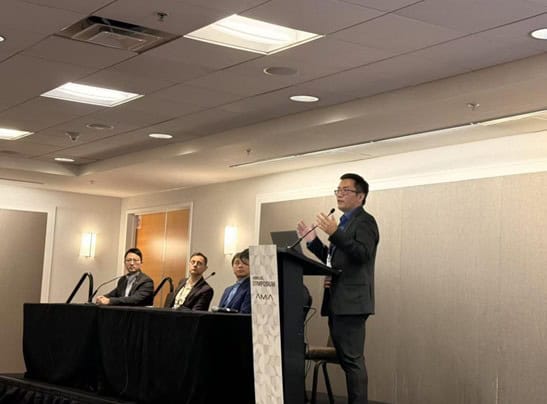
Dr. Zhe He, Director of the Institute for Successful Longevity and leader of the eHealth Lab, organized and chaired a full-day workshop, “Open-Source LLM Applications for Health Applications.” The event drew more than 100 attendees, reflecting strong national interest in open-source AI, model evaluation, multimodal capabilities, and reproducible pipelines for health research. The workshop featured a keynote, invited talks, a hands-on tutorial, and a panel discussion on HIPAA-compliant deployment of open-source LLM-based applications and trustworthy, transparent AI for healthcare.
During AMIA 2025, two members of the eHealth Lab—Dhruv Kale and Dr. Balu Bhasuran—delivered podium presentations showcasing novel applications of AI and machine learning for patient empowerment and clinical decision support.
Dhruv Kale, Application Developer in the lab, presented “LabGenie – A Patient-Facing AI-Powered Application for Empowering Older Adults to Act Upon Laboratory Test Results.” His talk highlighted the AHRQ-funded LabGenie system and its integration of large language models, human-centered design, and EHR-informed question generation to improve lab result comprehension among older adults.
“The AMIA 2025 Annual Symposium was an excellent platform to showcase our work and learn from leading researchers in health informatics. It was exciting to see how the field is advancing and how AI can meaningfully support healthcare,” said Kale.
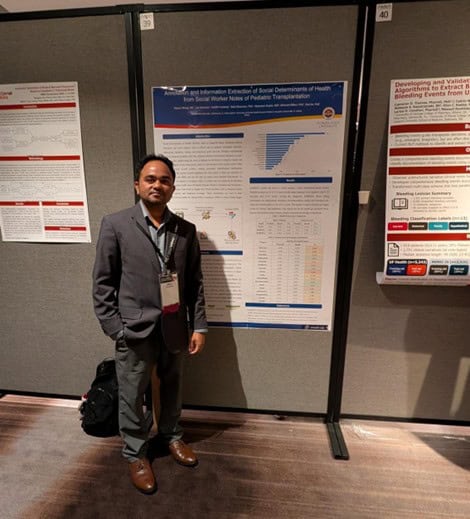
Dr. Balu Bhasuran, Research Faculty in the eHealth Lab, presented “Interpretable Machine Learning Models for Predicting Organ Rejections for Pediatric Heart Transplantations with the Combined Use of Electronic Health Records and Transplant Registry Data.” His presentation showcased advanced interpretable modeling techniques to improve post-transplant risk prediction and clinical decision-making for vulnerable pediatric populations.
In addition to his oral presentation, Dr. Bhasuran presented a poster, “Annotation and Information Extraction of Social Determinants of Health from Social Worker Notes of Pediatric Transplantation.” The poster demonstrated new annotation schemas and NLP pipelines to identify psychosocial risk factors often buried within unstructured clinical notes—an important step toward more holistic, equitable transplant care.
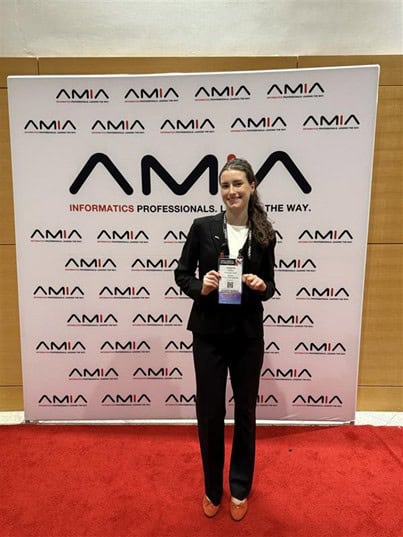
Undergraduate researcher Victoria Valko, a member of the eHealth Lab, served as an official AMIA Student Volunteer, supporting session logistics and gaining exposure to leading national research in clinical informatics, AI, and data science. Her participation reflects the lab’s commitment to mentoring emerging talent and engaging students directly in national-level scientific communities. “This was my first time attending AMIA, and it was truly eye-opening. The experience broadened my perspective and understanding of the health informatics field, reaffirming my excitement to contribute to the space,” said Victoria.
“Our participation at AMIA 2025 demonstrates the power of collaboration across disciplines and career stages,” said Dr. He. “From innovative research on lab result interpretation and prediction of health outcomes for pediatric transplantation to pioneering work with open-source LLMs, our lab continues to push the boundaries of what AI can do for healthcare.”