
Dr. Kelly Farquharson, speech-language pathologist, professor, and director of the Children’s Literacy and Speech Sound (CLaSS) lab at Florida State University, presented her research poster, Phonological profiles of children with speech sound disorders: Preliminary data from one academic year, with doctoral student Alexis Moser at the 33rd Annual Conference of the Society for the Scientific Study of Reading (SSSR), in Rotterdam, the Netherlands.
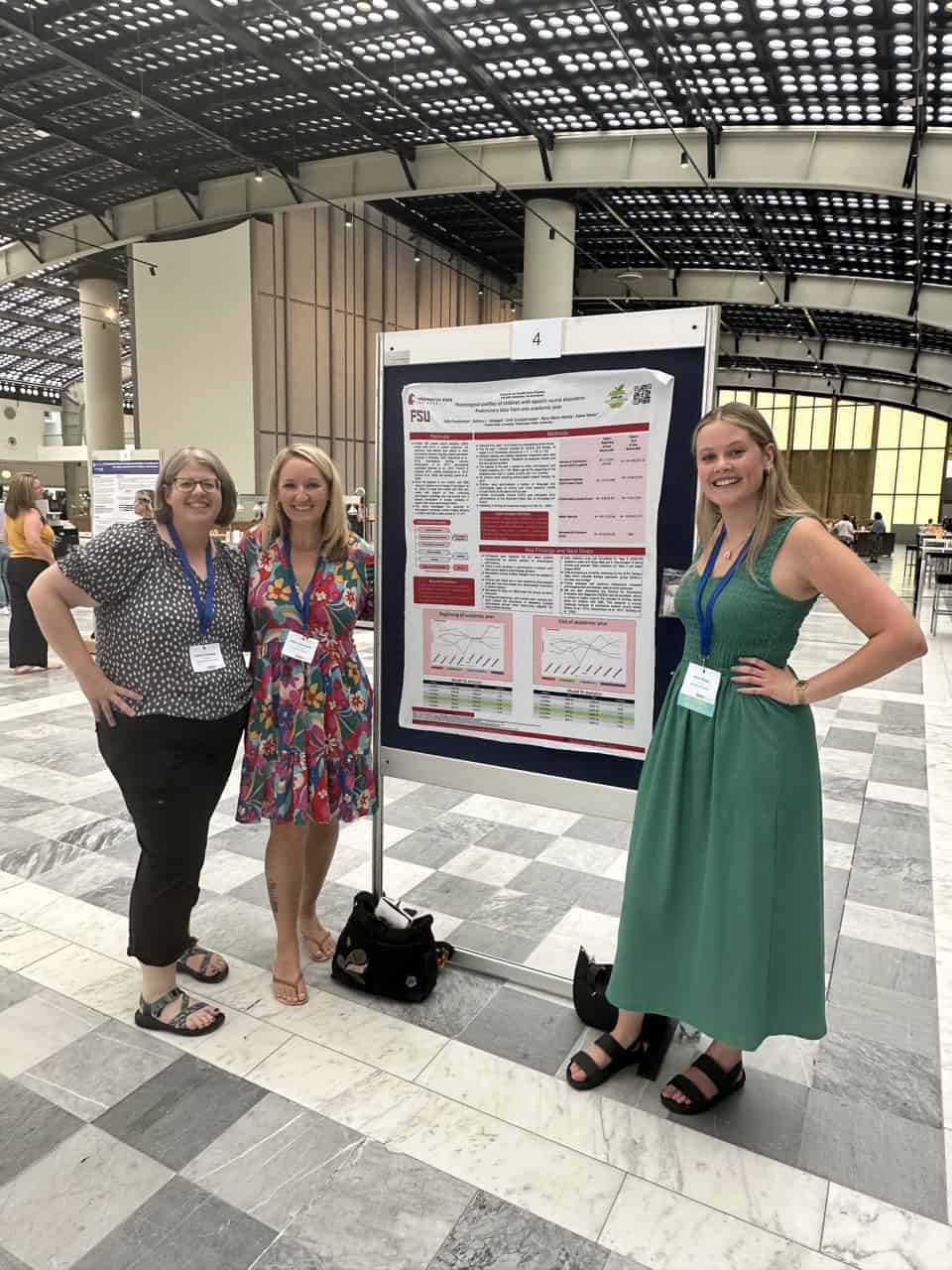
“SSSR is an important venue for the dissemination of reading research. The attendees are from all over the world, and we collectively work to understand how to support children’s reading needs across languages and settings,” said Farquharson. “It was wonderful to have one of my doctoral students, Alexis Moser, and to meet with my Co-Principal Investigator, Dr. Katy Cabbage. We spent a lot of time planning out the future directions of this work, which we are very hopeful to continue.”
They presented findings from the first year of the Academic Progress and Phonological Learning in Elementary School (APPLES) project, an NIH-funded study led by Farquharson and her co-investigator, Dr. Katy Cabbage, at Washington State University.
A common clinical myth is that children with speech sound disorders are a homogeneous group; the preliminary research results indicate that first and second graders with speech sound disorders are a heterogenous population. They differ in phonological awareness skills, which are necessary precursors for reading; and differ in speech perception and word reading skills. These results have implications for how these children may receive services in school-based settings.
“It has been very rewarding to contribute to such a large collaborative project, and I am grateful for the opportunity to continue working on it over the next two years,” said Moser. “Presenting at SSSR helped me to gain new perspectives, meaningful connections, and a deeper appreciation for the overlap between speech and literacy research.”
Attending the sessions on implementation science, research-practice partnerships, and motivation in reading research provided the biggest takeaways and inspiration for Moser on how reading researchers are working to support children’s confidence, motivation, and overall reading experiences in addition to their academic reading outcomes.
“Those sessions challenged me to think about how similar ideas could be applied in speech-language pathology to equip clinicians with tools that support not just children’s speech accuracy but also their confidence, participation, and experiences communicating,” said Moser.
Children with speech sound disorders, like those studied within the APPLES project, are often underserved for literacy. Sometimes they present reading difficulties that are “hidden” by speech production errors. The researchers hope, with this presentation and further research to come, to support these children and educators who work tirelessly to help them.