
FSU School of Communications Science & Disorders (SCSD) professor and doctoral program coordinator Dr. Yunjung Kim recently presented research in collaboration with FSU College of Medicine and San Diego State University at the 2026 International Congress of Parkinson’s Disease and Movement Disorders. The conference was held on Oct. 4-8 in Seoul, South Korea.
The research examined speech changes across repeated sentence productions in people with Parkinson’s disease. Researchers focused on a phenomenon known as “festinating speech,” in which speech becomes progressively faster while articulatory movements may become smaller. They also investigated whether deep-brain stimulation (DBS), a treatment used for some people with Parkinson’s disease, affected these patterns.
The project grew out of observations about how speech can vary among people with the disease and even within the same speaker.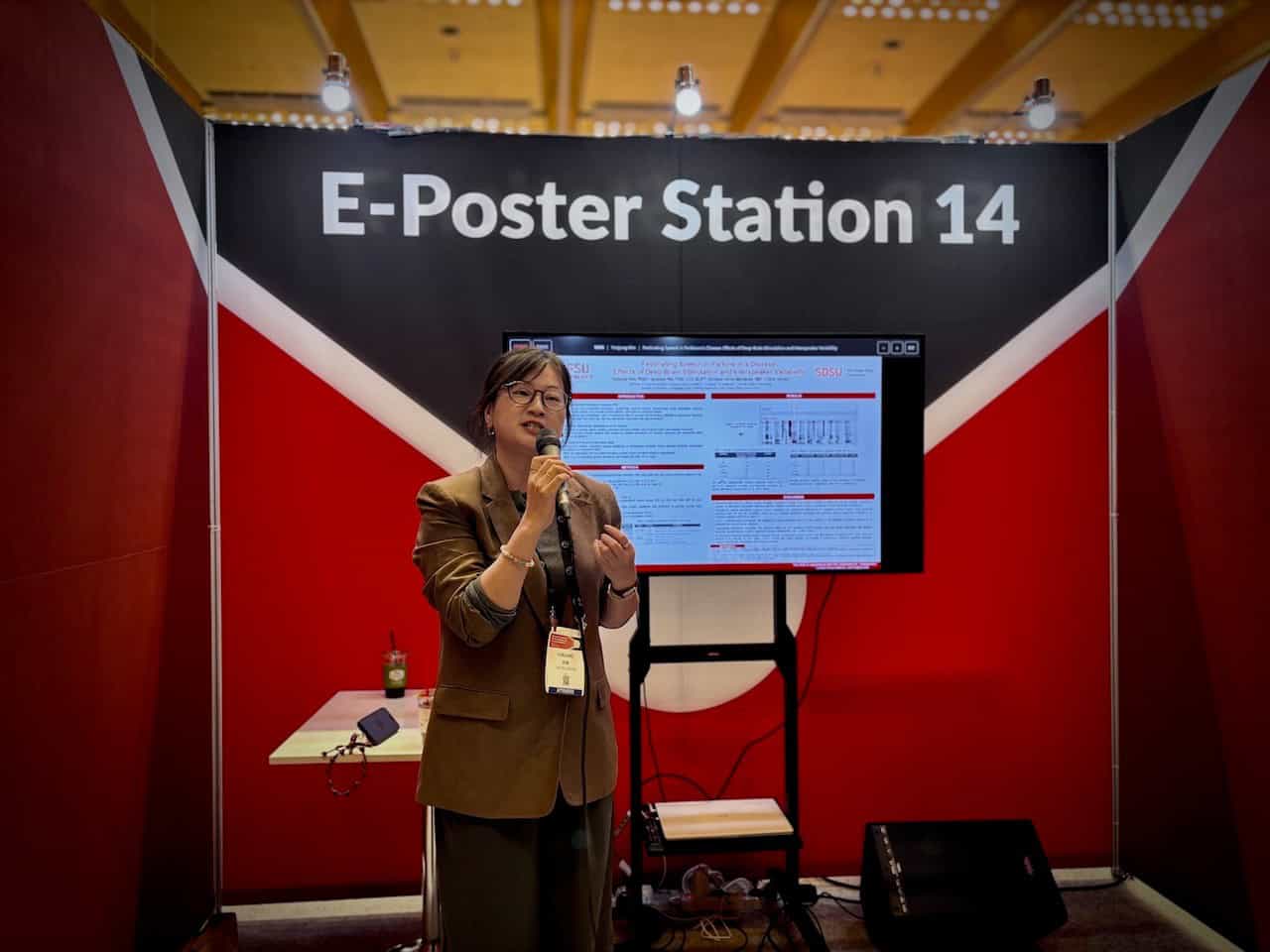
“We wanted to understand whether some of that variability follows a systematic pattern across repetitions,” Kim said.
The study included 27 participants, including people with Parkinson’s disease with and without DBS, as well as healthy controls. Participants repeated the same sentence 10 times, allowing researchers to track changes across productions.
Compared with healthy controls, participants with Parkinson’s disease showed greater decreases in sentence duration, intensity duration, and one measure of vowel acoustics. However, the results varied among individual participants. Those differences were not clearly explained by factors such as age, disease duration, or overall speech impairment. Researchers also found no significant differences in repetition-related speech changes when DBS was on versus off.
To Kim, the findings have implications for how clinicians evaluate speech in people with Parkinson’s disease.
“One practical message is that a single speech sample may not capture the full picture,” Kim said. “How a person’s speech changes across repeated productions may provide useful information that an average score overlooks.”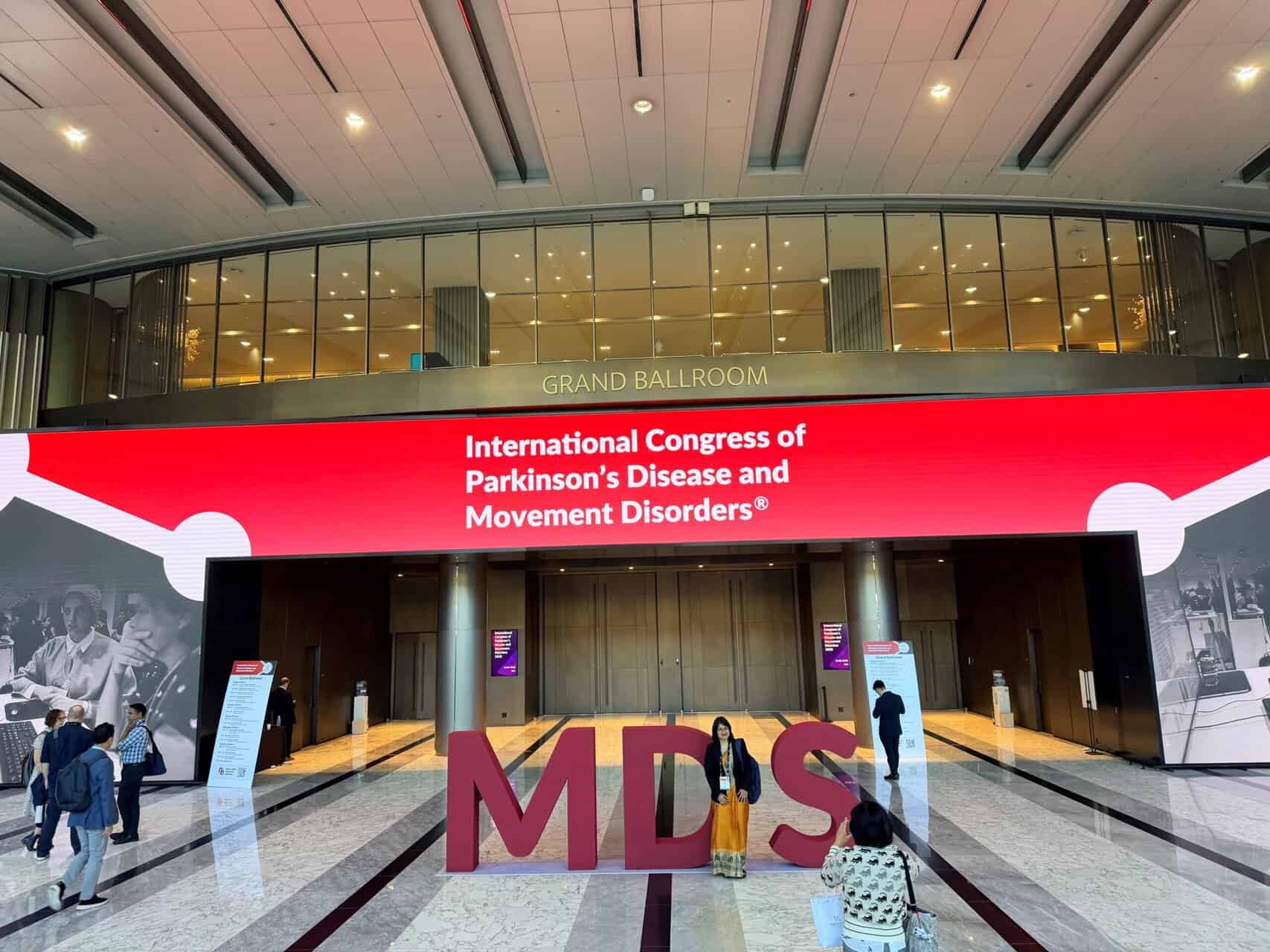
Kim said the conference also expanded her perspective on the future of motor speech research. Since she typically attends conferences focused on motor speech, participating in this international gathering dedicated to Parkinson’s disease and movement disorders allowed her to engage with researchers outside of her usual professional community.
As a Seoul native, Kim had a personal connection to the conference’s location.
“It was wonderful to return for work to the city where I grew up, with the schools I attended nearby, and share our research with an international community,” Kim said. “The visit brought together my personal connection to the city and my professional commitment to improving.”
Kim hopes future research will involve more partnerships among clinical sites and universities to better understand how communication interacts with motor symptoms, cognition, and mental health.
“I am especially interested in collaborations that consider both individuals with Parkinson’s disease and their family caregivers, including their emotional well-being, communication needs, and roles in rehabilitation,” Kim said. “My hope is that these collaborations will lead to research and care that better support people with Parkinson’s disease and the families who support them.”