
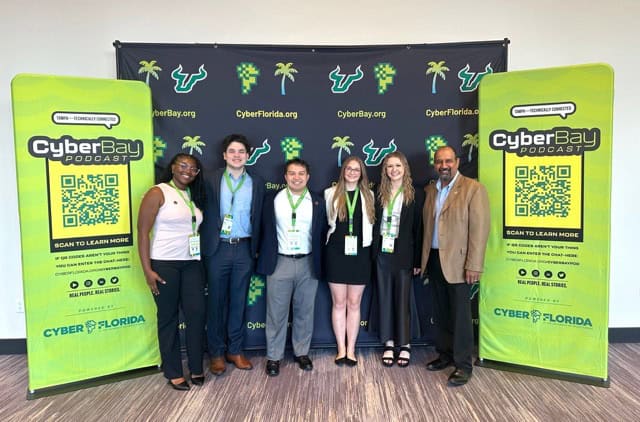
School of Information (iSchool) students gained firsthand exposure to emerging cybersecurity challenges and industry trends during the CyberBay 2026 Conference in Tampa.
The conference brought together industry leaders from government, academia, and the private sector to explore the ever-changing cybersecurity landscape, with artificial intelligence taking center stage. For these iSchool students, they gained a deeper understanding of current industry threats and what skills are needed to address them.
Information Technology (IT) student Sierra Blythe emphasized how necessary cybersecurity is in an increasingly digital world.
“Attending CyberBay 2026 reinforced just how critical cybersecurity has become in today’s environment,” Blythe said. “Protecting our data is more important than ever, especially as AI continues to be leveraged in increasingly sophisticated scams,” Blythe also emphasized the human element of cybersecurity. “Ultimately, one of the biggest takeaways is that people remain the greatest vulnerability, and improving user awareness is just as important as advancing technology.”
Throughout the conference, students attended sessions on artificial intelligence, risk management, and cybercrime, including panels on AI-driven threats, ethical AI, and hands-on labs where they practiced penetration testing and incident response techniques. Keynote speakers included Jen Easterly, former Director of the Cybersecurity and Infrastructure Security Agency (CISA), and Rachel Wilson, former National Security Agency (NSA) executive and Head of Wealth Management Data Security and Infrastructure Risk at Morgan Stanley.
Other sessions highlighted emerging technologies and practical skills, such as post-quantum cryptography, AI-powered botnet detection, next-generation security platforms, featuring experts like David Kim, Kurt Friday, and Ryan Seymour.
“The main theme was AI and your data,” M.S. IT student Owen Van Lenten said. “Some of my favorite workshops were David Kim’s talk on risk assessments of AI ecosystems and how to maximize your security through proper workflows to minimize data leakage and still leveraging AI effectively. There was a lot of conversation around the topic of AI governance and data ownership too.”
Beyond gaining technical knowledge, the conference also emphasized critical thinking in this rapidly evolving field. College of Communication and Information Associate Dean Ebrahim Randeree highlighted how artificial intelligence is reshaping both risks and opportunities in cybersecurity.
“The conference provided affirmation that AI is shaping every industry; students must understand how to use it (and its limitations). Cyber and AI bring strength to the protectors and the hackers—graduates must develop skills to think critically, problem solve, communicate, work in teams, and more. We should not be preparing students for the jobs that exist today, but for the threats that don’t yet have names.”
IT student Tanya Raphael echoed the same sentiment.
“When it came to cybersecurity, I always thought offensive and defensive tactics were one and the same, but this conference helped me understand that the real difference is timing,” Raphael said. “We are always looking to defend our systems before threats even happen, but it’s time to play offense—producing and maintaining quality software to achieve maximum protection.”
For these iSchool students, CyberBay 2026 was more than a networking opportunity; it was a glimpse into the future of cybersecurity. As cybersecurity continues to evolve alongside artificial intelligence, experiences like CyberBay are helping prepare the next generation of professionals to meet challenges that are still emerging.