
Dr. Sladjana Lukic, Assistant Professor in the School of Communication Science and Disorders (SCSD) and Director of the Neurobiology of Language and Behavior Lab at Florida State University (FSU), has been awarded a $50,000 Clinical Catalyst Grant from the FSU Office of Research to support her clinical research in stroke aphasia. The Clinical Catalyst grant is awarded annually and funds projects that bring together FSU researchers with local healthcare providers. This year, Dr. Lukic was awarded the grant for her research on facilitating improved rehabilitative outcomes for patients who have suffered strokes.
Dr. Lukic’s proposal titled “Feasibility, acceptability, and preliminary efficacy of Vagus Nerve Stimulation for Stroke Aphasia” discusses her goal of developing community research by pairing neuromodulation with scalable, digital home-based speech-language therapy to increase access to care. If successful, this work could expand the range of evidence-based interventions available to speech-language pathologists and create new opportunities for personalized rehabilitation. As the project moves forward, Lukic hopes the findings will help shape the future of aphasia rehabilitation.
“The biggest overall goal is to successfully engage those individuals with chronic aphasia into everyday life,” said Dr. Lukic. “We think that this vagus nerve stimulation (VNS) can enhance language recovery beyond what has already been given with traditional rehabilitation, which will allow us to refine treatment protocols and think more about patient-centered approaches.”
Researchers and healthcare providers are given the opportunity to connect at the Clinical Catalyst event at FSU, allowing 12 providers the opportunity to share the challenges they face in their practice. It was at this event that Dr. Lukic was able to connect with Dr. Narlin Beaty, a neurosurgeon at Tallahassee Memorial Hospital, after hearing him talk about his work on VNS in post-stroke motor recovery. Since then, they have been able to work together and form a team for their research on stroke aphasia recovery.
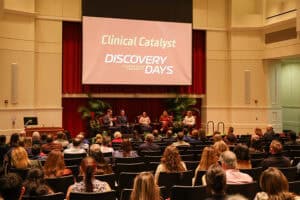
“The Clinical Catalyst happened, and that’s where I saw Dr. Narlin Beaty talk on surgical VNS and how it accelerates recovery of complex motor behaviors,” said Dr. Lukic. “I spoke to him after, and we both thought that as a team we would like to combine VNS and language therapy to address the most important challenge that these people face in stroke recovery.”
The focus of Dr. Lukic’s research on stroke aphasia and rehabilitative processes comes from the digital speech-language therapy synchronized with their active VNS device that would allow patients to receive treatments and care in their homes. This research bridges a gap between necessity and accessibility for patients who face challenges in post-stroke recovery.
“Imagine if you have a digital rehabilitation tool, and you have a device that is kind of implanted. You can have your therapy anywhere,” said Dr. Lukic. “This could be a continuous therapy that you receive at home, and I think that’s where we’re seeing the most importance.”
Equally important to the funds received by the Clinical Catalyst program are the people working on these developments and the team that is formed. Dr. Lukic has been able to create a team of people who are devoted to the research at hand and to finding solutions for stroke recovery and rehabilitation.
“The most important thing is the team,” said Dr. Lukic. “The moment I was actually able to form the team, we were equally excited and driven to succeed and see the potential in this research, and I think that passion of every member speaks through the grant proposal.”
Dr. Lukic also acknowledged the support she received from colleagues and collaborators who helped form the research team that has played a key role in advancing her stroke recovery research.
“I am specifically grateful to Dr. Joseph Frascella, a Chief Clinical Research Officer for FSU and TMH, who helped me connect with various people and physicians from TMH to facilitate this partnership that has led to a successful proposal and an important milestone in my research program as an early-stage Investigator.”
As Dr. Lukic and her team develop their research, their goals and passion persist. Their focus on communication as a foundation for human independence and commitment to speech recovery for patients drives their research forward.
“Communication is fundamental, and it’s a quality of life that’s very much affected by a stroke”, said Dr. Sladjana Lukic. “If I can do anything as a clinician and as a researcher, I would like to give them back language.”